Stearyl Amine: Real-World Impacts and Future Perspectives
Historical Development
People started using stearyl amine long before folks began looking at ingredient lists or safety datasheets. In the early decades, chemists experimented with fatty amines, aiming to create agents that helped in textiles and surfactants. As the oil and chemical industries grew after the Second World War, the demand for reliable surfactants steered more attention toward higher aliphatic amines. By the sixties and seventies, stearyl amine found its way into a mix of processes, from anti-static coatings in plastics to ore flotation in mining. Stearyl amine’s lift into everyday chemistry proved that sometimes, the simplest molecules could change a whole industrial routine. Innovation never stops, so each decade brought new synthesis routes, purer grades, and more consistent product quality. Today, even though the basics haven’t shifted much, the drive for higher performance keeps pushing the development of modified amine products based on lessons learned over a lifetime of trial, error, and industrial accidents.
Product Overview
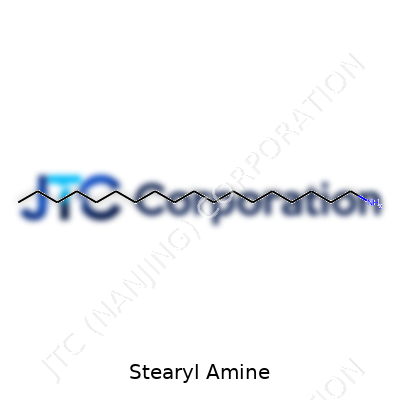
Stearyl amine does not collect much hype in consumer media, but folks in the chemical industry know its value. It stands as a primary fatty amine, composed of an eighteen-carbon alkyl chain attached to a single amine group. This structure gives it a stubbornly waxy feel, a faint, fishy odor, and a character that usually gets bottled in drums or solid bricks. Chemical plants sell it both in its pure form and blended into functionalized surfactants. Product grades range from technical to high-purity, depending on whether it goes into dyes, lubricants, or pharmaceuticals. Off-the-shelf, the product looks like a pale wax; on lab benches, it’s a feedstock for something more complex. Every specification matters, since a batch with residual acids or moisture causes headaches in reaction vessels and final formulas.
Physical & Chemical Properties
Stearyl amine sits solid at room temperature. It melts at about 50°C and boils at above 300°C, so standard storage doesn’t trouble logistics teams much. The molecule’s long tail carries an oily, hydrophobic punch, while the single amine head delivers modest solubility in water and better compatibility with organic solvents. That’s the spot where its surfactant properties emerge: one foot in water, the other in oil. Add stearyl amine to a solution and it’s ready to coordinate with acids, form salts, or attach itself at the water-oil interface. That oily nature also makes it stand up to many acids and weak bases, but not strong oxidizers. Chemists and operators running pilot plants quickly learn that even moisture or a splash of acid throws off a batch’s pH and causes secondary odors or discoloration.
Technical Specifications & Labeling
Standard stearyl amine often appears on labels as octadecylamine, with a molecular formula of C18H39N. It usually contains over 97% active content, with limits set for moisture (less than 0.5%), acid value (under 3 mg KOH/g), and low color values. Packing slips must detail batch numbers, grade type, expiration dates, storage care, and hazard statements. CAS number 124-30-1 identifies it internationally. Certification documents dig deeper, listing compliance with REACH, TSCA, and other chemical management laws. Labels warn about skin, eye, and inhalation hazards, as even a small spill stings or leaves a lasting odor in confined spaces.
Preparation Method
Factories often synthesize stearyl amine from stearic acid, a common fatty acid sourced from animal fats or plant oils. The typical manufacturing process goes through catalytic hydrogenation, producing stearyl alcohol, which then reacts with ammonia under high temperature and pressure, using metal catalysts to yield the desired amine. This reaction throws off small amounts of side products, including secondary and tertiary amines, so operators run purification steps by distillation and crystallization. My own experience in a pilot plant taught me that controlling pressure swings and catalyst lifecycle means everything—small missteps lead to off-grade batches, lost yield, and unnecessary waste handling.
Chemical Reactions & Modifications
In most labs, stearyl amine reacts briskly with mineral acids to form salts, a cornerstone step for making textile softeners or emulsifiers. It participates in alkylation or amidation reactions, so chemists tweak it for specialty surfactants or corrosion inhibitors. When exposed to oxidizing agents, the amine group oxidizes to the corresponding nitroso or nitro derivative, though that path’s less popular for marketable goods. Skilled chemical engineers harness stearyl amine’s surface activity to modify minerals or coat pigments. My hands-on runs showed just how fiddly those conditions can get—pH swings, local heat spikes, and even equipment fouling challenge any lab tech aiming for consistency. Seasoned operators anticipate these quirks, tuning conditions based on years of bench-worn experience.
Synonyms & Product Names
Stearyl amine shows up under a bunch of labels: octadecylamine, N-octadecylamine, or stearamine—pick your industry and you’ll run into different trade names. Market leaders stamp their own brand marks: Armeen 18D, Ethomeen O/12, and Duomeen O emerge in product catalogs, even though the underlying molecule does not change. In foreign markets, translations and synonyms cloud the picture, so shipping and regulatory teams stay alert for confusion in customs paperwork and global safety sheets. Regulatory compliance means checking the cross-index of product names and making sure every barrel matches its marked grade and documentation.
Safety & Operational Standards
Handling stearyl amine requires solid safety habits. It irritates skin and eyes. Dust or vapor—especially on hot process lines—causes respiratory issues or headaches for workers. Chemical plants set up enclosed handling, strict personal protective equipment, and exhaust ventilation around melting or dosing stations. Storage calls for drums in dry, cool areas, away from oxidizers or acids. Training rounds repeat the lesson: even small spills cause persistent odors, slippery surfaces, or emergency eyewash events. OSHA lists it as hazardous, and shipping rules treat pure forms as regulated cargo. Lost-time incidents creep up fast when folks shortcut procedures—delivering a hard-learned lesson that’s stuck with every manager I’ve known.
Application Area
Stearyl amine’s reach looks broader than most outsiders guess. Its anti-static properties rule in plastics processing, especially for polyethylene and polypropylene films. Mine processing engineers rely on it in ore flotation for separating minerals, another process that walks the fine line between science and art. Textile finishers add it to cationic softeners and antistatic finishes for fibers, making fabrics easier to cut, sew, and wear. Paint formulators blend it into dispersions to stop pigment clumping, and water treatment vendors prize its ability to neutralize anionic surfactants. In oilfield chemistry, it serves as a backbone for corrosion inhibitors—an expensive product, but necessary for pipelines, refineries, and drilling fluids. Each industry brings its own quirks and demands tighter quality controls, so not all stearyl amine is made equal in the eyes of downstream specialists.
Research & Development
Researchers still dig into the possibilities stearyl amine opens up. Labs optimize catalytic systems for higher yields, less energy, and lower waste, hoping to curb emissions or reduce costs. Some chemists chase new amine derivatives to unlock greener or more selective processing agents. Elsewhere, nanotech engineers look at stearyl amine as a particle modifier, seeking improved dispersions or biocompatibility in pharmaceutical carriers. Environmental teams run models and field tests for new water purification cycles, and regulatory scientists audit chemical fate in industrial effluent. Most innovation grows from hands-on work, close study, and the occasional breakthrough in process scale-up or impurity control.
Toxicity Research
Stearyl amine does not fly under the radar of health agencies. Studies link it to skin and eye irritation, as well as moderate toxicity by ingestion or inhalation. Chronic exposure causes liver or kidney stress in animal models, while aquatic studies report toxicity for fish and invertebrates, raising red flags for water and waste management teams. Regulatory tides shift as more data emerges on long-term or low-level exposure. Responsible facilities monitor worker health, enforce PPE, and invest in treatment systems. Environmental safety means constant vigilance, spill containment, and up-to-date hazard reviews—lessons I’ve picked up after seeing the aftermath of poorly-managed amine dumps or accidental releases.
Future Prospects
Looking ahead, stearyl amine may face both headwinds and tailwinds. Pressure mounts for safer, more sustainable chemicals. Green chemistry research seeks plant-based, renewable feedstocks, reducing reliance on animal fats or fossil oils. Biotechnology looms on the horizon, with engineered microbes promising someday to produce fatty amines in fermenters. Regulatory changes may tighten limits or push the industry to find less toxic or more biodegradable alternatives. Applications in nano-formulation and advanced coatings still generate excitement among young researchers and startup teams. The next era of stearyl amine will need both creative science and practical experience, blending new environmental mandates with the age-old demand for tough, effective chemical agents. Every change—whether driven by markets, laws, or science—means real-world impacts for operators, consumers, and communities who depend on chemistry to keep modern life moving.
Tracing Stearyl Amine’s Uses Beyond the Lab
Stearyl amine doesn’t show up in everyday conversation, but its fingerprint turns up across a surprising number of products and processes. I’ve often found that understanding these background chemicals is a great way to see how industry connects to our daily lives. With a slippery texture and waxy feel, stearyl amine steps into a range of roles, handled by scientists, manufacturers, and sometimes farmers. This isn’t just a technical ingredient; its influence rolls out in places you might not expect.
Helper in Making Everyday Items
In plastics manufacturing, stearyl amine acts as an antistatic agent. Without chemicals like this, plastic containers would snap and crackle with every touch. I remember opening up new electronics and seeing how dust loves to stick; that static is something manufacturers work hard to prevent. Stearyl amine’s job is making sure plastic doesn’t act like a magnet for every dust particle in the room.
Paper production also leans on stearyl amine for similar reasons. Handling a stack of printouts, it’s easy to forget just how many treatments paper goes through before landing on my desk. Stearyl amine helps manage static, which keeps sheets from clinging together on the production line. Paper companies rely on this trait to maintain steady output and avoid costly jams and delays.
Care for Surfaces, Metal and More
Corrosion remains a stubborn enemy for industries dealing with metal. Stearyl amine gets mixed into coatings that shield against rust and moisture. If I think back to an old bike left out in the rain, all that flaking is corrosion at work. On a larger scale — ships, cars, bridges — industries use chemicals like stearyl amine to slow down nature’s constant assault on metal. It’s one ingredient in a bigger formula, but skip it and that protective layer loses strength.
You’ll also find stearyl amine in lubricant formulations. By sticking to metal surfaces, it helps machine parts glide with less friction. Fewer breakdowns and longer run times save businesses serious money. As someone who has fought with rusty garden tools or a squeaky door hinge, I get that difference between irritated metal-on-metal and the smooth movement a good lubricant gives.
Stearyl Amine in Farming
Agriculture isn’t short on chemicals, and stearyl amine pops up in herbicide production. It keeps weed-killers distributed evenly on leaves. A field treated with patchy coverage wastes money and time — not to mention, weeds get the advantage. Stearyl amine helps create a sticky coating, making sure the active ingredient stays where it can do its work.
Health and Safety Questions
No chemical story feels complete without looking at health and safety. Stearyl amine, like many amines, can irritate skin and eyes. Workers handling it wear gloves, goggles, and sometimes full face shields. For the average consumer, there’s not much direct contact — it disappears within finished goods. Still, there’s a call for more transparent labeling and access to safety data. Occasionally, I’ve read about concerns in community forums, people asking, “Is this stuff safe in my house?” Most routine uses pass product safety reviews, but greater knowledge empowers both workers and consumers.
Moving Toward Responsible Use
Regulators and manufacturers have started looking for greener alternatives, balancing effectiveness with environmental impact. There’s growing pressure to check for persistent residues and ecosystem harm, since stearyl amine doesn’t break down easily in water. Research points at biodegradable replacements, but changing an established supply chain takes time. My experience says practical shifts happen only after clear rules and responsible leadership push them through. We need efforts from both science and policy, so this helper chemical doesn’t turn into an unwanted guest in water, soil, or air.
Looking Closer at Stearyl Amine
Standing in the pharmacy aisle, scanning ingredient lists, you might notice “stearyl amine” in the fine print. This chemical shows up in industrial uses and, less often, in some personal care products. On the surface, it doesn’t get as much attention as other skincare ingredients, and that alone is worth pausing for a closer look.
Understanding the Risks
Stearyl amine works as an anti-static and emulsifier, often turning up in cleaning agents or processes that call for fabric softeners. Most people never think about it unless they work with chemicals or spend a lot of time on ingredient research. Looking through databases from the European Chemicals Agency and the Environmental Working Group, this compound tends to have red flags popping up for skin irritation. Workers who handle industrial quantities often need protective gloves because reports show cases of contact dermatitis. In labs, tests on animals frequently end with skin reactions at higher doses, but that doesn’t always translate directly to how humans experience lower, incidental exposure.
What Happens With Direct Skin Exposure?
Direct contact paints a mixed picture. Small amounts might not stir up trouble for everyone, but sensitive skin types or people with existing allergies sometimes react quickly. Swelling, redness, or itching have all cropped up in medical case reviews involving occupational exposure. The National Institutes of Health points out that, as a class, fatty amines like stearyl amine break skin barriers if the concentration climbs high enough or if exposure repeats over time.
Manufacturers argue the amounts used in finished cosmetics are much lower than the concentrations that trigger issues in lab settings. For the general public grabbing a bottle of fabric softener, risk looks low compared to a factory worker dumping barrels of the raw stuff. Still, the idea that something won’t bother everyone rarely brings much comfort to those with skin conditions or young kids at home.
Studies and Guidance
The US Food and Drug Administration keeps a long checklist of safe ingredients for personal care products, but does not specifically approve or ban every single compound. Most experts point to the guidelines from the Cosmetic Ingredient Review panel, which periodically reviews ingredients for safety. At the last round-up, very little evidence appeared for long-term, low-dose risks from small amounts found in cosmetics, but the studies usually called for more data on how the chemical interacts with delicate or damaged skin.
One thing I’ve learned from years of covering ingredient safety is that even substances called “low hazard” can build up risks with regular exposure. People working with raw stearyl amine, like industrial laundry staff or lab workers, have higher odds of irritation. For most folks, the average product on a drugstore shelf doesn’t seem to pose dramatic danger, though there’s always the chance of unique sensitivity.
What Can Concerned Users Do?
Some people want to rule out even the smallest chance of irritation. For those folks, patch testing a small dab on the forearm goes a long way. Reading product labels and asking brands about their sourcing and testing helps, too. If a rash or reaction pops up, switching to simpler, fragrance- and amine-free products often clears the issue.
Keeping companies accountable matters here. They bear responsibility to run thorough safety tests and answer questions without hedging. Building trust with customers depends on real transparency about ingredient sourcing and exposure risk. Healthcare professionals and parents often advocate hardest for clearer safety standards — and in my experience, their voices shape safer product development over time.
What Stearyl Amine Really Is
Stearyl amine comes from a long chain fatty acid called stearic acid. It’s a compound that shows up in both science labs and industry production lines, often appearing as a waxy, white solid. The chemical formula looks pretty neat: C18H39N. The long tail of stearyl amine means it’s hydrophobic at one end and reactive at the amine (NH2) group.
My days in a polymer chemistry lab taught me that small changes in chemical structure can mean big differences in real-world usage. For instance, swapping the end group of a fatty chain determines if it will repel or attract water, interact with metals or bind to plastics. In the case of stearyl amine, the NH2 head sticks out, giving it special value for surfactants, lubricants, and even ore processing chemicals.
Why This Molecule Matters
People often overlook where basic chemicals go after leaving a factory. With stearyl amine, it plays several parts, all related to its structure:
- Surfactants: It helps oil and water mix, working behind the scenes in cleaning products and cosmetics. The amine group latches onto surfaces, while the fat tail keeps it anchored in oily domains.
- Industrial processes: In mining and ore flotation, this compound catches onto mineral particles, making them float so they can be separated. Here, chemistry meets the dirt and grime of everyday resource extraction.
- Fabric softeners: Its structure makes clothes feel soft by coating fibers, reducing static, and making everything a bit more comfortable.
Looking at Risks and Solutions
Stearyl amine isn’t without its problems. Long-chain amines can raise questions about skin sensitivity and environmental buildup. Handling powders in the plant always meant wearing gloves, goggles, and paying attention to ventilation. Studies report that amines like this can irritate the skin and eyes if you don’t take care.
Recent research by agencies focusing on chemical safety highlights how nitrogen-based tails, especially those with a long carbon chain, may not break down quickly in the environment. They can end up in water systems and cause trouble for aquatic life. Tracking and managing waste can reduce the risks.
Solutions don’t have to throw out the good with the bad. Manufacturers in Europe and North America have shifted to closed systems and increased monitoring of effluents. Using biodegradable alternatives or methods to filter out amines before wastewater exits the plant has gained ground. These efforts didn’t spring from regulations alone. I’ve met plant managers who set up community partnerships just to address local river health, recognizing that clean water benefits everyone.
Responsibility from Lab to Life
Knowing the chemical formula is just one part of understanding why stearyl amine draws interest and raises concerns. It’s the connection between chemistry, health, and environment that matters. Staying alert to new research and improving how these materials are handled helps safeguard people and nature. My own work with industrial chemists and environmental engineers showed me that every choice in a supply chain adds up, from the formula written on a bottle to the water that flows past your local creek.
Keeping Stearyl Amine Out of Harm’s Way
Stearyl amine does a lot of heavy lifting in industry—everything from fabric softeners to corrosion inhibitors. A clear understanding of its storage doesn’t just tick a safety box; it protects people and keeps businesses running smoothly. I’ve seen what happens when chemicals get stashed away without proper care. Gritty research and first-hand experiences drive home the same lesson: cutting corners can get costly in a hurry.
Room Temperature Isn’t a Free Pass
You might spot recommendations suggesting that a cool, dry room is “enough.” At first glance, that feels simple, even reassuring. But there’s more beneath the surface. Stearyl amine, in its pure form, carries some risks—especially if heat or moisture get involved. Left in a sunlit warehouse or a damp storage closet, it starts to break down, clump up, or turn into something nobody should breathe in. Once, walking through an old industrial lab, I opened a back cupboard barely bigger than a breadbox, only to find a sticky stearyl amine spill attracting dust, bugs, and worry. All it took was a cracked window and a forgotten air vent.
Why Ventilation and Containment Matter
Well-designed storage means giving chemicals a proper home, not just any available shelf. Chemical-resistant containers—usually made from polyethylene or stainless steel—are the best call for keeping stearyl amine contained and away from accidental contact. Good seals on containers do more than prevent leaks. They help keep humidity at bay, which is a big deal since water reacts with the amine and can create a mess or even a hazard.
Ventilation takes the worry out of air quality changes, especially when temperature rises or material gets handled. Fumes from amines cause headaches and worse if left unchecked. I remember a small company where poor airflow in the chemical storage meant staff lost a whole day clearing lingering fumes. That was a lesson nobody forgot.
Labeling—Small Habit, Big Impact
Every chemical container needs a label that won’t fade or fall off after a week. A torn or smudged label tells you nothing and mistakes happen fast—one misstep and someone grabs the wrong bottle. I learned early on to mark every single container before it even made it to the shelf. Keep the label simple: product name, concentration, any hazards, and a date. That makes audits and emergencies both move faster. The National Fire Protection Association (NFPA) system has saved many headaches—using color-coded diamonds goes a long way to making things obvious.
Location Choices That Pay Off
Tucking chemicals away might sound easy, but proximity changes everything. Keep stearyl amine away from oxidizers and acids—you don’t want two materials hissing at each other from across a crowded shelf. Separate storage for incompatible substances means fewer surprises. On busy sites, dedicated chemical cabinets with lockable doors keep the curious and untrained away.
A commitment to regular check-ups works wonders. Containers age, seals loosen, and sometimes accidents slip by unnoticed—the smallest crack can spell trouble down the road. Spot inspections catch weak links before they break.
Solutions for Real Peace of Mind
Concrete steps set the tone: sealed chemical-resistant containers, fully readable labels, dry and ventilated storage, and routine checks for leaks or changes. Keep training current and make sure everybody in the building knows how to handle the material back to front. If issues pop up—such as a strong smell or container bulging—get the right safety team involved right away, don’t wait.
Practical storage never sounds glamorous, but it keeps workplaces safer and avoids risks that nobody wants to clean up. Every step pays back in reliability and peace of mind.
What’s Stearyl Amine and Why It Catches Attention
Stearyl amine isn’t exactly a household name, but you’ve probably encountered it more often than you think. This waxy material comes from beef tallow or coconut oil, landing in the hands of chemists and engineers for good reason. I once toured a textile plant where the air felt damp and static clung to every sleeve. A plant manager waved a sample bottle, explaining how a little chemistry made smooth fabric more than marketing talk. That’s what stearyl amine helps do—a small detail with a big impact.
Textiles Rely on Chemistry
Spinning yarn calls for smooth processes. Factories treat fibers with antistatic agents to keep dust and lint from clumping. Stearyl amine, thrown in with fabric softeners and chemical finishes, keeps those threads sleek from factory floor to home closet. It reduces static and helps dye stick better. Over the years, technological improvements have cut down on waste, but fabric makers still count on the right mix of chemicals to meet global demand for soft clothes. Cotton, polyester, acrylic—all find improvement through stearyl amine treatments, lowering snags and helping colors set deeper.
The Asphalt and Road Construction Connection
Next time you drive, look at the road under your wheels. Asphalt paving needs sticky additives that help gravel and tar bond. Stearyl amine stands out as an anti-stripping agent. Road builders sprinkle it into bitumen so rain doesn’t wash the pavement apart. I’ve watched crews in the heat douse rocky roadbeds as they pour new surfaces, and chemical suppliers say this additive keeps highways intact longer. Reliable roads keep costs down and cargo moving, so there’s real value in this simple molecule.
Paints, Inks, and Everyday Finishes
Stearyl amine finds its way into coatings, where it helps paint stick to metal surfaces and prevents rust. Paint shops use it as a corrosion inhibitor—protecting bridges, outdoor furniture, and shipping containers. Printing inks benefit, too, using amine derivatives for cleaner printouts. A friend who runs a signage business swears that anti-corrosive chemicals save him money on touch-ups and replacements, illustrating a tangible impact in small business operations.
Personal Care and Cosmetics
It also travels quietly in soap and hair products. Conditioning agents often rely on long-chain amines like stearyl amine to detangle and soften hair. Hair conditioners, shaving creams, and some skin lotions get lasting texture and stability thanks to this ingredient. Cosmetic chemists watch safety standards closely, following research and regulatory changes, but many large brands use these compounds to tame, smooth, and moisturize. My dermatologist once traced my dry skin back to harsh soaps lacking such softening agents, nudging me toward products with improved emulsifiers.
The Ongoing Search for Better Solutions
Modern industry always pushes for safer, greener options. Producers research bio-based alternatives and batch improvements that lower waste and emissions. Manufacturing using stearyl amine must respect environmental and worker safety guidelines—the wrong handling leads to skin and respiratory irritation. Shifting toward sustainable production solves some problems but brings new challenges in sourcing and consistency. The story of stearyl amine showcases applied science feeding into everyday needs, from the roads we drive to the clothes we wash and the products we keep on our bathroom shelves.